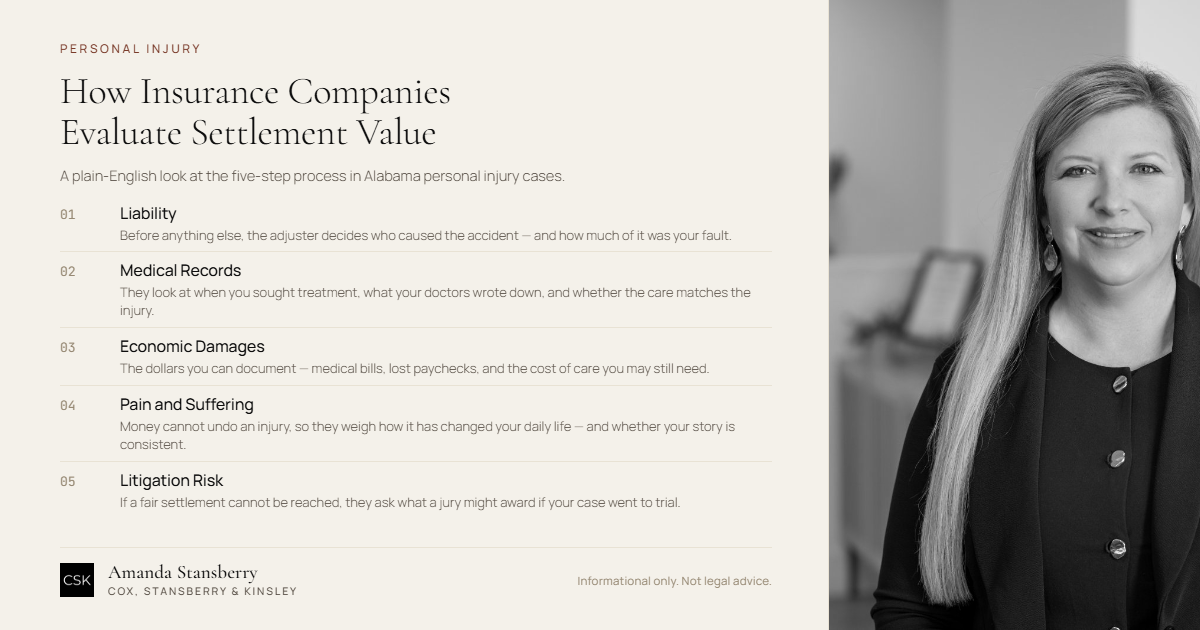
Insurance companies value Alabama personal injury claims through a five-step process: confirming liability under the state’s strict contributory negligence rule, reviewing medical records, calculating economic …
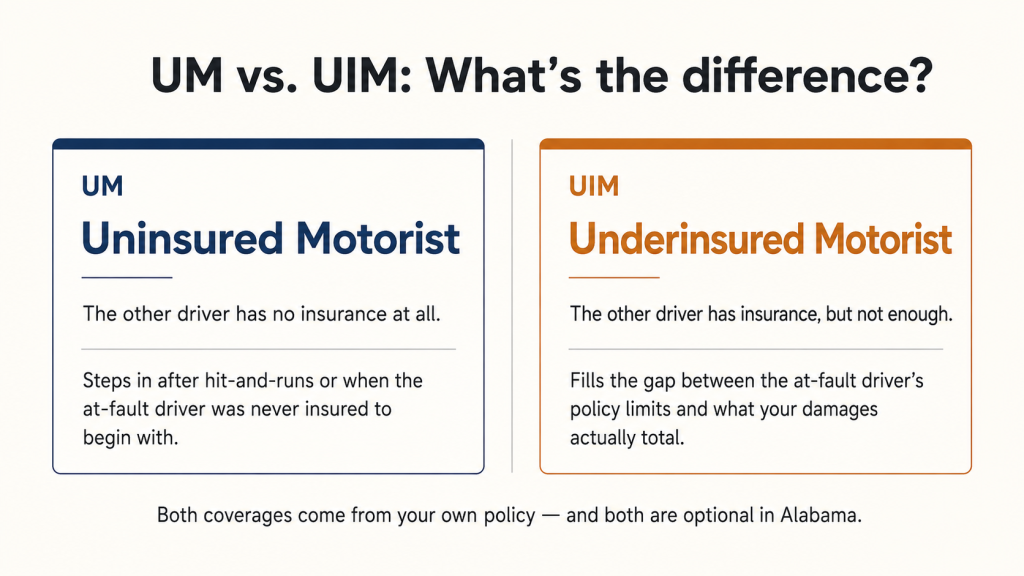
When the driver who caused your accident doesn't carry enough insurance, your own policy may be the most important safety net you have. This article explains how uninsured (UM) and underinsured (UIM) motorist coverage works in Alabama, including what each one covers, how they fit alongside the state's minimum liability limits of $25,000 per person and $50,000 per accident, and why those minimums often fall short after a serious wreck. It walks through how UM/UIM claims are filed against your own insurer, what you have to prove to recover, and how Alabama's strict contributory negligence rule can affect your case even when you're the one who was hurt. It also covers the settlement steps that matter most in UIM cases, including why you should never sign a release from the at-fault driver's insurance company without first notifying your own UIM carrier. Along the way, it answers common questions about coverage limits, premiums, passengers, and the right time to review your policy, all aimed at helping Alabama drivers understand where they stand before an accident ever happens and what to do if one already has.
The first 72 hours after a car accident in Alabama can determine whether you are able to recover compensation at all. Because Alabama follows a strict contributory negligence rule—where even 1% fault can bar recovery—what you say, when you seek medical care, and how you interact with insurance companies matter more than in almost any other state. This guide walks through the critical steps to take immediately after a crash, how to protect your health and your claim, and the common mistakes that can quietly undermine your case before you realize it.
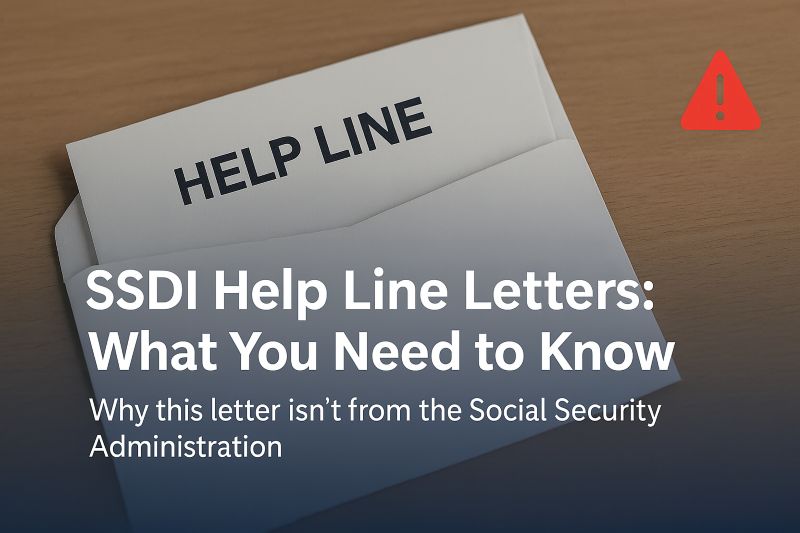
If you’re applying for Social Security Disability Insurance (SSDI), you’re already managing a lot—doctor’s visits, paperwork, and the uncertainty of your financial future. The last ...
The Employee Retirement Income Security Act of 1974 (ERISA) is a piece of federal legislation that is intended to protect enrollees in most private retirement ...
For those who suffer from a debilitating injury or illness, Social Security Disability benefits are a necessity. Unfortunately, however, not all disabled people are eligible ...
The Employee Retirement Income Security Act of 1974 (ERISA) is a federal law that provides employees with protections of their long-term disability benefits. Thus, ERISA’s ...
If you’ve been denied Social Security disability benefits and wish to appeal the denial, you will eventually have to attend a Social Security disability hearing. ...
There are two primary types of long-term disability insurance: ERISA disability insurance and individual disability insurance. ERISA disability insurance is provided by employers, while individual ...
No representation is made that the quality of the legal services to be performed is greater than the quality of legal services performed by other lawyers.